



1994 Graduate Employment Survey Report - April 1996
General information
Questionnaires for the Biochemical Society's twenty third survey of graduate employment were sent to one hundred and three institutions of higher education in the UK. Eighty four (81%) of these institutions responded, seventy three (70%) returning the completed questionnaires, with the remainder commenting that they either ran no relevant courses or were unable to provide graduate employment figures at that time.
The response rate of 70% of institutions returning completed questionnaires is a slight improvement on the 67% return rate for the 1993 survey and the Professional and Education Committee thanks those institutions which participated.
In response to the many comments received in previous years the questionnaire for the 1994 survey was considerably shortened and simplified. The main changes made were as follows;
the survey no longer asked if the students were male or female;
there were no questions regarding the number of students enrolling on a biochemistry course, or the subsequent movement of students between courses;
no attempts were made to follow the employment histories of biochemistry graduates after a post-doctoral placement;
questions regarding the staffing of biochemistry departments were omitted.
Whilst the Professional and Education Committee hopes that such simplifications made completing the survey easier and less time-consuming, it regrets that the changes necessarily limited the number of comparisons that could be made between the 1994 graduate employment survey and those of previous years.
For the purposes of this survey "biochemistry graduates" were defined as those students for whom biochemistry constituted at least 50% of the total degree course, irrespective of the title of the degree obtained. A list of all first degree titles that were considered by the responding institutions to meet this criterion is given in Appendix 1. MSc, whether taught or by research, and MPhil degrees, were not differentiated but are referred to as "MSc". Appendix 2 lists the courses from which the figures concerning MSc Biochemistry graduates were drawn.
Since the number of higher education institutions completing the questionnaire was similar in 1993 and 1994 it is considered that meaningful comparisons between the two years can be made from the percentage figures for graduates falling within particular employment categories.
Total numbers of biochemistry graduates of all levels entering employment
The number of biochemistry graduates returned by the participating institutions increased from 1859 in 1993 to 2467 in 1994. Whilst this was from a slightly larger proportion of higher education institutions in 1994 (70% of total compared to 67%) the change would appear to reflect a genuine increase in the total number of biochemistry graduates entering employment.
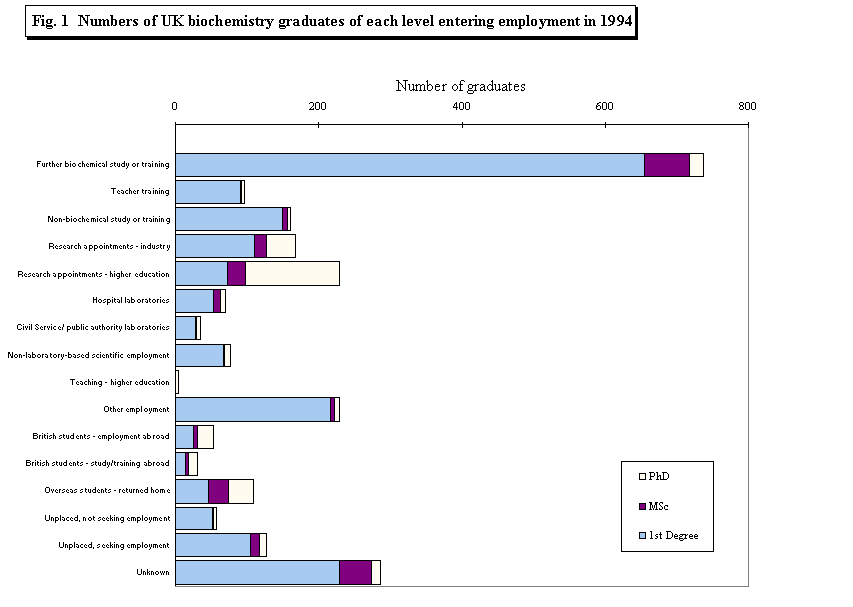
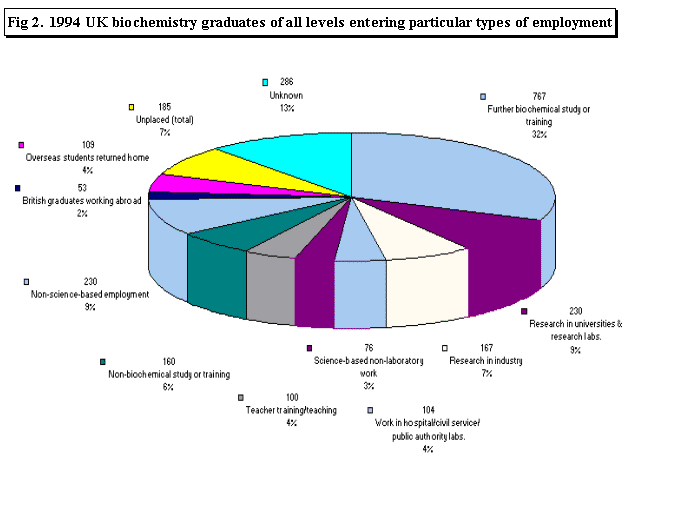
The actual numbers of UK biochemistry graduates of all levels entering different categories of employment are listed in Table 1 and shown as a bar chart in Fig 1. The categories are defined and explained in Appendix 3. Figure 2 indicates in the form of a pie diagram the percentage of total graduates entering particular types of occupation. For simplicity some of the categories listed in Table 1 have been combined in this, and in subsequent figures and tables; thus, data on hospital, civil service or public authority laboratories were pooled to represent laboratory-based biochemical work other than research in academia or industry; teacher training and teaching in higher education were also combined, as were the two categories of unemployed graduates. It can be seen that the largest single group of biochemistry graduates continued with further biochemical study or training in the UK (737; 31.1% total) or abroad (30; 1.2% total), this obviously being skewed towards first degree and MSc graduates. These figures cannot be compared directly with those for 1993 since in the current survey post-doctoral researchers not on permanent positions within academia were included in the Research in universities and research institutes category whereas previously they were classified under Further biochemical study or training. The next highest categories of occupation were research in academia (230; 9.3% total), careers requiring graduate ability but no particular biochemical knowledge such as accounting and retail management (230; 9.3% total), research in industry (167; 6.8% total) and further training for careers outside biochemistry (160; 6.5% total). It should be noted that the latter category included intercalating medical students who had returned to their medical studies, who could not be distinguished in the present survey. Apart from the apparent large increase in researchers in academia, brought about largely by the change in classification referred to above, the percentages do not appear greatly changed from 1993. However, it is clear that there are other situations where direct comparison with previous surveys cannot be made. For instance, it is difficult to identify from previous survey data the positions included under Science-based non-laboratory work in the current survey and these may well have been classified as Employment outside biochemistry previously.
Graduates remaining in Biochemistry
Data in Table 1 are dissected further in Table 2 to indicate percentages of first degree graduates of different classes, MSc and PhD graduates in the various types of occupation. This table enables easy comparisons across degrees. The largest proportion of first degree graduates (35.0%) moved on to further biochemical study or training, principally in the UK. This figure is slightly higher than for 1993 (33.6%) but a little lower than for 1992 (37.6%). There was an even spread of classes 1 and 2 first degree graduates between the various biochemistry-based careers such as research in industry (6.1%) or academia (4.0%); work in hospital, public health, public analyst or forensic, laboratories (4.3%); science-based non-laboratory work (eg. management, sales, marketing in science-based industry, information science and editorial work) (3.7%); and teacher training (4.8%). A smaller proportion of graduates with class 3 or pass degrees undertook further biochemical training (12.3%) or biochemistry-based careers but a larger proportion than of classes 1 and 2 graduates entered non-scientific careers (25.5% compared to 9.8%). The largest single group of MSc graduates (29.6%) continued biochemical training. Relatively more MSc than first degree graduates entered research in academia (11.3%) or industry (7.8%) or into laboratory work (4.8%), with few choosing other science-based work or teaching. As would be expected, the largest single group of PhDs (40.0%) continued research in universities and research institutes, with fewer researching in industry (11.8%), undergoing further biochemical training (9.1%) or starting other laboratory-based careers (4.2%). It is likely that a large proportion of the 7.0% of PhDs working abroad were researching in academia but this was not revealed by the survey. A much larger proportion (36.3%) of PhDs than of first degree or MSc graduates continuing with biochemical training were doing so abroad. Of those entering teaching (2.4%), equal numbers started PGCE courses and teaching directly in higher education, whereas all first degree and MSc graduates in this category entered teacher training.
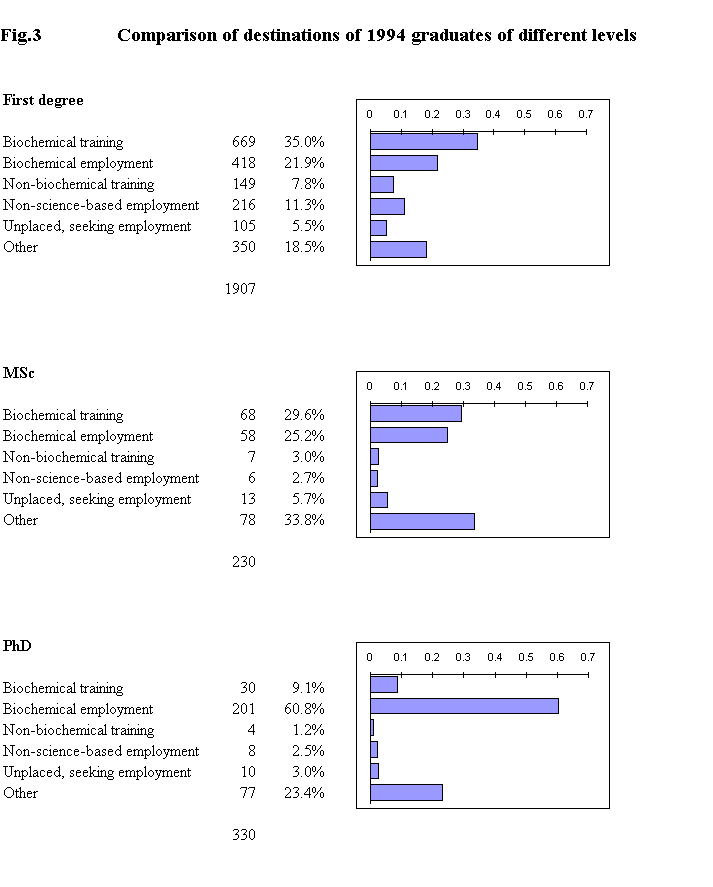
The actual numbers, and percentages, of the three levels of graduates remaining in biochemistry are shown in Fig 3. Since it is anticipated that graduates entering teacher training will become science teachers these have been included in the Biochemical employment category rather than Non-biochemical training. The percentages of first degree and MSc graduates remaining in biochemistry were similar (56.9 and 54.8%, respectively), and that of PhDs somewhat higher (69.9%). The figure for first degree graduates is higher than that obtained by combining corresponding data from the 1993 survey (49.9%), but this may be partially due to a difference in categorising non-laboratory-based scientific work, as noted above. There was little difference between the two years in the proportion of PhDs continuing in biochemistry (69.9% compared to 67.7% in 1993).
Graduates pursuing careers not involving biochemistry
This grouping covers those graduates who entered training for, or commenced, employment requiring degree-level ability but no specific biochemical knowledge, such as accountancy or retail management. The category Non-biochemical study or training also includes intercalating medical students, as noted previously. These will form a separate category in the 1995 survey but cannot be distinguished in the current one. The proportion of total graduates choosing a career outside biochemistry was 15.8%, a slight decrease on the 1993 figure of 18.8%, but note again that this may have been influenced by the categorisation of non-laboratory-based scientific work. Not surprisingly, a larger proportion of first degree (and in particular class 3 and pass degree graduates-see Table 2) than of the more specialised MSc or PhD graduates was included in this grouping (19.1% overall compared to 5.7 and 3.7%, respectively).
The interpretation of the whole survey is clouded to some extent by the lack of knowledge concerning the employment of British graduates working abroad and of overseas students returning home, and by the percentage of graduates whose employment position was not known, which was quite large for first degree (particularly class 3 and pass degree) and MSc graduates (12.1% overall, and 19.1%). Relative to total numbers few first degree or MSc students took employment abroad but a significant proportion (7.0%) of PhDs did. The percentage of PhDs either training or working abroad was similar to that in 1993 and 1992 (10.3% compared to 12.8% and9.8%, respectively). It is interesting to note that at least 10% of MSc and PhD graduates were overseas students, who returned home after qualifying. The figure for PhDs (10.9%) actually represents a small decrease over the previous two years (15.4 and 14.2%).
Graduates who were unemployed at the time of the survey
Of the 7.5% of total biochemistry graduates known to be unplaced at eight months after graduation only 5.2% were actively seeking employment, the remainder taking time out to travel, start a family, or in temporary jobs such as chalet staff or au-pairs whilst evaluating longer-term careers. There was some difference between the three levels of graduates in the proportion seeking work, PhDs (3.0%) being slightly lower than first degree classes 1 and 2 (4.9%) and MScs (5.7%), with first degree class 3 and pass degrees experiencing more difficulty (11.1%). The results of the last three surveys suggest that there has been a slow upward trend in unemployment of biochemistry graduates as a whole, 3.2% of total 1992 graduates being unemployed at the corresponding time and 4.5% of 1993 graduates. However, the unemployment figure for biochemistry first degree graduates in 1994 (5.5% overall) still compared favourably with those for other disciplines. According to University Statistics 1993-1994. First destinations of University Graduates, 8.5% of first degree graduates of all disciplines were still seeking employment six months after graduating and 9.9% of biological sciences graduates (a grouping which includes biologists, botanists, zoologists, geneticists, microbiologists and psychologists in addition to biochemists). The corresponding figures for higher graduates were 4.7% unemployment for all disciplines and 4.4% for biological sciences graduates. The relatively low level of unemployment of biochemistry graduates may reflect the fact that Biochemistry continues to be regarded as a numerate discipline which instils analytical skills and the ability to handle large amounts of complex information, skills which are in demand by a wide range of employers.
Report compiled by Mike Withnall and Teresa Waldin, Professional and Education Section
Table 1 - Numbers of UK biochemistry graduates, of all levels, entering employment in 1994.
| Type of employment | First degree | After MSc /MPhil |
After PhD | Total | |
|---|---|---|---|---|---|
| Class 1 and 2 | Class 3/ Pass | ||||
| 1.1 Further biochemical study |
634 | 21 | 63 | 19 | 737 |
| 1.2 Teacher Training |
83 | 7 | 2 | 4 | 96 |
| 1.3 Non-biochemical study or training |
139 | 10 | 7 | 4 | 160 |
| 2.1 Research Appointments - Industry |
105 | 5 | 18 | 39 | 167 |
| 2.2 Research appointments- Higher Education |
69 | 3 | 26 | 132 | 230 |
| 2.3 Hospital Laboratories |
49 | 3 | 10 | 8 | 70 |
| 2.4 Civil Service and Public Authority Laboratories |
25 | 2 | 1 | 6 | 34 |
| 2.5 Non-laboratory Based Employment |
64 | 3 | 1 | 8 | 76 |
| 2.6 Teaching-Higher Education |
0 | 0 | 0 | 4 | 4 |
| 3 Other Employment |
170 | 46 | 6 | 8 | 230 |
| 4.1 British students-Employment abroad |
22 | 3 | 5 | 23 | 53 |
| 4.2 British students-Study/training abroad |
13 | 1 | 5 | 11 | 30 |
| 4.3 Overseas students-Returned home |
39 | 6 | 28 | 36 | 109 |
| 5.1 Unplaced, not seeking employment |
44 | 7 | 1 | 5 | 57 |
| 5.2 Unplaced, seeking employment |
85 | 20 | 13 | 10 | 128 |
| 6.1 Unknown |
186 | 43 | 44 | 13 | 286 |
| TOTALS | 1727 | 180 | 230 | 330 | 2467 |
Table 2 - Occupations of 1994 Biochemistry graduates
Data for 1907 first degree, 230 MSc/MPhil and 330 PhD graduates eight months after graduation
| % total graduates | |||||
|---|---|---|---|---|---|
| First degree | MSc | PhD | |||
| Overall | Class 1&2 | Class 3/Pass | |||
| Further biochemical study or training |
34.3 0.7 |
36.7 0.8 |
11.7 0.6 |
27.4 2.2 |
5.8 3.3 |
| Research in Universities and Research Institutes | 3.8 | 4.0 | 1.7 | 11.3 | 40.0 |
| Research in Industry | 5.8 | 6.1 | 2.8 | 7.8 | 11.8 |
| Work in hospital/ civil service/ public authority labs. | 4.1 | 4.3 | 2.8 | 4.8 | 4.2 |
| Science-based non-laboratory work | 3.5 | 3.7 | 1.7 | 0.4 | 2.4 |
| Teacher training/ teaching | 4.7 | 4.8 | 3.9 | 0.9 | 2.4 |
| Non-biochemical study or training � | 7.8 | 8.0 | 5.5 | 3.0 | 1.2 |
| Non-science-based employment | 11.3 | 9.8 | 25.5 | 2.7 | 2.5 |
| British graduates working abroad, career unspecified | 1.3 | 1.3 | 1.7 | 2.2 | 7.0 |
| Overseas students returned home | 2.4 | 2.3 | 3.3 | 12.1 | 10.9 |
| Unplaced, including those not currently seeking work | 8.2 | 7.5 | 15.0 | 6.1 | 4.5 |
| Unknown | 12.1 | 10.7 | 23.8 | 19.1 | 4.0 |
Appendix 1 - First degree course titles that were considered, by the responding institutions, to contain at least 50% biochemistry in their final year (the figures are the number of institutions that offered a course of that particular title)
| Non-honours biochemistry | 1 |
| Biochemistry | 41 |
| Biotechnology | 4 |
| Combined Studies (Life Sciences) | 2 |
| Biochemistry with management | 2 |
| Biochemistry with a year in Europe | 2 |
| Biochemistry with a year in the USA | 1 |
| Biochemical Sciences | 2 |
| Biochemistry with a year in industry | 3 |
| Chemistry and biochemistry | 4 |
| Chemistry and biotechnology | 1 |
| Chemistry and biochemistry with a year in industry | 2 |
| Chemistry and biotechnology with a year in industry | 1 |
| Biology | 2 |
| Biochemistry and physiology | 5 |
| Animal Science | 2 |
| Biomedical technology | 2 |
| Molecular Biology | 2 |
| Biology and Chemistry | 1 |
| Applied biochemistry | 4 |
| Biochemistry with molecular biology | 1 |
| Biochemistry with combined studies | 1 |
| Biochemistry and biological chemistry | 1 |
| Biochemistry and genetics | 1 |
| Biochemistry and microbiology | 5 |
| Molecular Cell Biology | 4 |
| Medical Biotechnology | 1 |
| Medical Biochemistry | 6 |
| Biological Sciences | 3 |
| Bioanalytical Science | 1 |
| Plant Sciences | 1 |
| Biochemistry and biology | 1 |
| Biochemistry and botany | 1 |
| Biochemistry and zoology | 1 |
| Biochemistry and marine biology | 1 |
| Biochemistry and pharmacology | 3 |
| Applied biochemistry and food science | 1 |
| Biological and medicinal chemistry | 1 |
| Biochemistry and applied molecular biology | 1 |
| Biochemistry and clinical biochemistry | 1 |
| Biochemistry and German | 1 |
| Biochemistry and immunology | 2 |
| Biochemistry with nutrition | 1 |
| Analytical chemistry | 1 |
| Molecular genetics in biotechnology | 1 |
| Biological sciences (physiological biochemistry) | 1 |
| Cell biology and biochemistry | 1 |
| Applied cell biology and biochemistry | 1 |
| Genetics and molecular biology | 1 |
| Biochemistry and biotechnology | 3 |
| Biochemistry and molecular cell biology | 1 |
| Applied biology | 2 |
| Biochemistry (toxicology) | 1 |
| Biomedical sciences | 1 |
| Biochemistry and business | 1 |
| Environmental biochemistry | 1 |
| Biochemistry and molecular biology | 2 |
| Biochemistry and psychology | 2 |
| Medical molecular biology | 1 |
| Joint honours in science | 1 |
| Biological and medicinal chemistry | 1 |
| Intercalated BSc in biochemistry | 5 |
Appendix 2 - MSc course titles that were considered, by the responding institutions, to contain at least 50% biochemistry (the figures are the number of institutions that offered a course of that particular title)
| Environmental diagnostics | 1 |
| Environmental sciences | 1 |
| Information Management | 1 |
| Nutrition | 1 |
| Toxicology | 2 |
| Biochemistry (research) | 1 |
| Medical biochemistry | 1 |
| Biomedical sciences | 1 |
| Biochemical immunology | 1 |
| Biotechnology | 3 |
| Biological sciences | 1 |
| Fungal technology | 1 |
| Biochemistry | 1 |
| Human molecular genetics | 1 |
| Applied molecular biology and biotechnology | 1 |
| Plant biotechnology | 1 |
| Bioreactor systems | 1 |
| Biochemistry and genetics | 1 |
| Clinical biochemistry | 2 |
| Biochemical pharmacology | 1 |
| General biochemistry | 1 |
| Biochemical endocrinology | 1 |
| Plant biochemistry and productivity | 1 |
| Genetic and manipulation and molecular biology | 1 |
| Cellular and molecular plant services | 1 |
| Neuroscience |
Appendix 3 - A description of the employment categories
| Section 1: Further Study/Training | |
|---|---|
| 1.1. | Further biochemical study or training Includes postgraduate courses for MSc, PhD and research assistantships where the assistant is registered for a higher degree by research. |
| 1.2. | Teacher training, eg PGCE courses. |
| 1.3 | Non-biochemical study or training Includes courses in accountancy, law, computing, library and information work etc., also intercalating medical students and any others taking a year off from a course of study to do a biochemical degree then returning to their original studies. Those taking professional qualifications whilst in employment have been classified under 3. |
| Section 2: Employment that requires biochemical knowledge | |
| 2.1 | Research Appointments-Industry Both temporary and permanent employment are included. CASE students are classified under 1.1. |
| 2.2 | Research Appointments-Research Institutes, Institutes of Higher Education Post-doctoral research is included in this section. |
| 2.3 | Hospital laboratories |
| 2.4 | Civil Service and Public Authorities Includes government and local authority laboratories which are mainly involved in applied or service work, public health and public analyst laboratories etc. |
| 2.5 | Non-Laboratory Based Employment Management and management training, sales, marketing, information and editorial work where scientific knowledge is required but the work is not laboratory-based. Also includes direct entry into teaching in schools and further education colleges - not those catering for degree-type work. Teacher training courses are classified under 1.2. |
| 2.6 | Teaching-Higher Education Permanent and temporary teaching appointments in institutions of higher education. |
| Section 3: Non-scientific Employment | |
| 3 | Other employment Any jobs that require no specific scientific knowledge and so are open to graduates of any discipline. |
| Section 4: Abroad | |
| 4.1 | Employment abroad Any employment abroad unless of a temporary nature. The type of employment was not revealed by this survey |
| 4.2 | Study/Training Abroad Any type of study or training abroad similar to that described under Section 1. It is assumed that this will be of a biochemical nature. |
| 4.3 | Returned home This section includes any non-British students who have returned to their home country after studying in the UK. If a foreign national has remained in this country for further study or to take up employment he/she has been classified in the appropriate section. |
| Section 5 : Unplaced | |
| 5.1 | Unplaced, not seeking employment Those who have opted out, eg. to travel, to bring up a family. Also includes those who are filling in time in temporary jobs whilst looking for a permanent post in their chosen career eg. au-pairs, chalet-girls etc |
| 5.2 | Unplaced, seeking employment These are the truly unemployed - still trying to find a job. |
| Section 6 | |
| 6.1 | Unknown. |
59 Portland Place,
London W1B 1QW;
Tel: 020 7580 5530; Fax: 020 7637 3626;
E-mail: [email protected]